

I have never known a December without Handel’s Messiah. We are partial to the Robert Shaw recording of the Atlanta Symphony and Chamber Chorus in our household; it bursts forth as I type. Though it was written for a chamber setting, I first sang the Christmas portion in a mass choir when I was sixteen years old in the most un-cathedral-like setting of the University of Georgia’s Coliseum. The power and emotion of so many voices was not diminished by the arena built for basketball and rodeo. The upper register required for the tenor part is only a memory for me now. Then as now, I particularly love the choruses for they carry such explosions of joy. Can any of us imagine the heavenly chorus that appeared to the shepherds in the Gospel of Luke singing anything other than Handel’s “Glory to God.” Some might complain that it is overplayed, that it is a cultural cliche, and that it should be shelved so that we might appreciate it more fully. Perhaps, but I am still deeply moved by the opening “Comfort Ye” and still hear my mother’s voice joining in on “For Unto Us.” This year, “Every Valley,” Isaiah’s gloriously imagined infrastructure project, speaks an odd truth to the endless highway construction at every turn in our area.
Truth to tell, in this season, I need Handel’s Messiah. I need the reminder of the prophetic imagination. I need the explosions of joy.
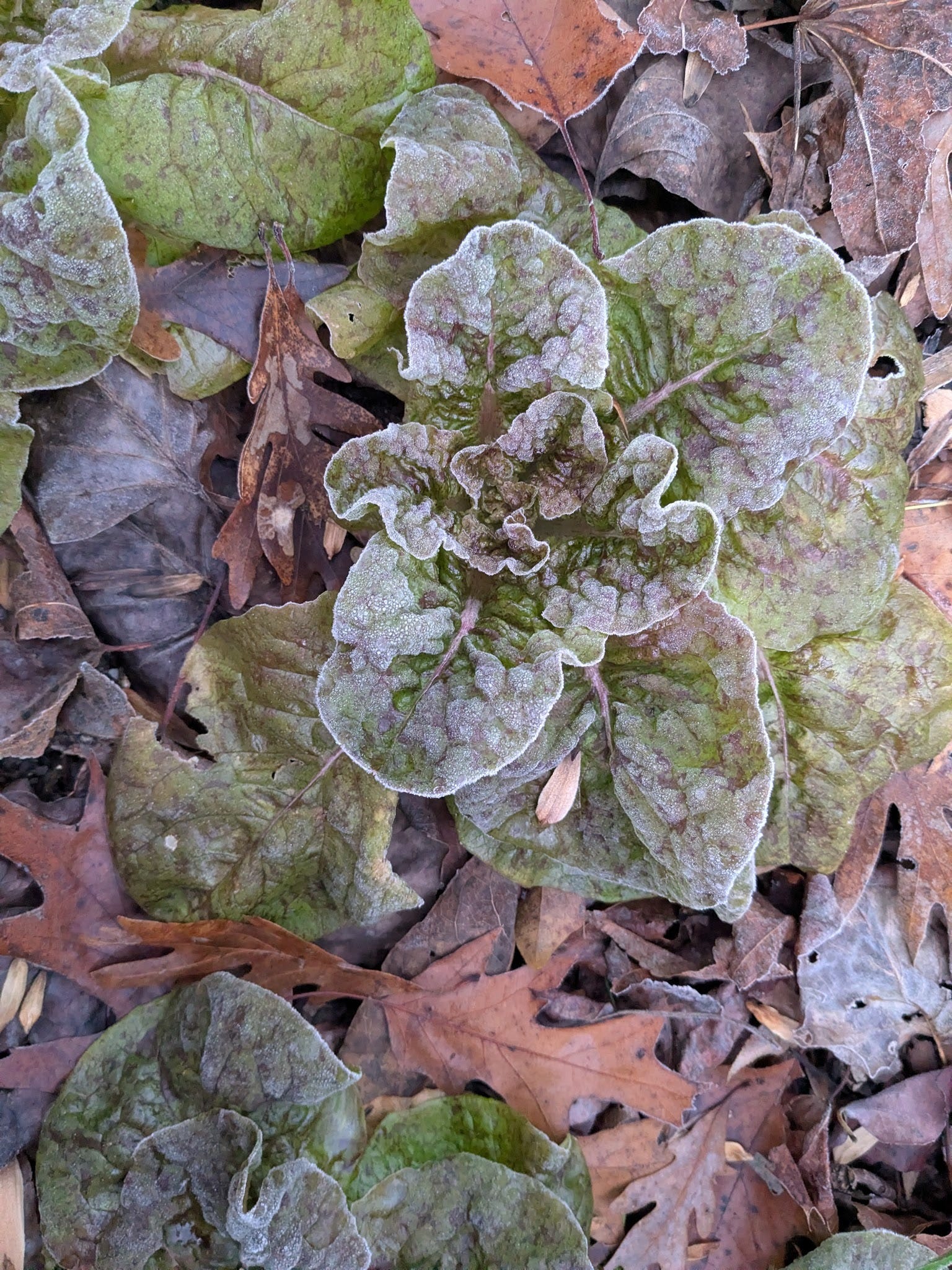
Here, in the Georgia Piedmont, we have just entered the Persephone Period in the garden cycle of the year, the season when we receive fewer than 10 hours of daylight a day. Persephone has left for the underworld, as the ancients understood it, taking hours of daylight with her, leaving her mother, Demeter, behind to mourn. Most of our gardens wear her brown cloak of grief. Our fall/winter garden still sports an array of greens for salads, some hardy root crops, broccoli, and cauliflower, and these plants are mature enough to manage the short days and cold nights, but their growth has slowed to near stop. Though I greet them each morning, sometimes admiring the frost that heightens their sweetness, there is subdued joy in our communion. It is not the exuberance of summer. All of us seem only to be marking time till longer days return.
There seems to me a certain wisdom in the church calendar placing Advent and Christmas in the bleak midwinter. We need at least a star’s worth of hope in the dark night. We need some wild words from the prophets. We need the promise of a messiah.
I don’t know how the Hebrew prophets ever came to be thought of as foretelling the future. Rather, I find their prophecy is about creative persuasion; they are metaphor makers and performance artists, and they are truth tellers in ways that force us to pay attention; they are an incarnation of hope. They, in a turn I much appreciate, often draw on the natural world for poetic insight.
From the despair of the Babylonian exile, Isaiah writes,
The wilderness and the dry land shall be glad,
the desert shall rejoice and blossom;
like the crocus it shall blossom abundantly,
and rejoice with joy and singing.
The glory of Lebanon shall be given to it,
the majesty of Carmel and Sharon.
They shall see the glory of the Lord,
the majesty of our God.
Crocuses are delightful early bloomers here, certainly avatars of hope and joy as spring approaches. They are native in Palestine and grow wild and common in the cooler, wetter corners. Famous for their winter whites and spring yellows, they are a marker of abundance. Isaiah calls on these beauties to proclaim the promise of restoration of the land and the people, a restoration so abundant that all will “rejoice with joy and singing.” The poet offers a dramatic memory of home for his people in exile. Isaiah plants seeds, or bulbs in this case, for a spring bloom, and thus conjures hope. For me, in the bleakness of Advent, in the darkness of the Persephone Period, the passage inspires me, enlivens me, and it makes me want to plant crocuses.
Surely as Isaiah is a poet, Jeremiah is a performance artist:
The word that came to Jeremiah from the Lord: “Come, go down to the potter’s house, and there I will let you hear my words.” So I went down to the potter’s house, and there he was working at his wheel. The vessel he was making of clay was spoiled in the potter’s hand, and he reworked it into another vessel, as seemed good to him.
Then the word of the Lord came to me: Can I not do with you, O house of Israel, just as this potter has done?
When I was young, I had an overly earnest faith, a faith that was regularly searching for, listening for, longing for the voice of God in my life. And when I would read such a passage, I knew that God was indeed (preferably in the voice of James Earl Jones) speaking to Jeremiah in a very real and literal way.
These days I hear a very different voice of God. In my mind, I see Jeremiah absent-mindedly knocking his favorite coffee cup off the shelf and breaking it. Much in need of caffeine, he stumbles down the street to the potter to get a replacement. While there, he watches the potter take a botched project and turn it into a beautiful new pot. Having purchased his new coffee cup he heads home. Then stimulated by the caffeine but still cranky about breaking his mug and the shekels he had to pay the potter, he says to himself, “Isn’t that just like God.” After a few revisions it came out, “Thus says the Lord…”
Now don’t get me wrong. In no way do I mean to suggest that God’s hand and God’s voice are not in the prophecy. Quite the contrary. Rather, Jeremiah stumbled upon a metaphor, a metaphor that helped him see in a new way and that gave voice to what God was saying to him. This clay is not ruined; this people can be reborn.
My favorite performance artist of scripture is John the Baptizer. Scripture tells us he channels Isaiah: “The voice of one crying in the wilderness: Prepare the way of the Lord.” He is the wildest character of scripture, a performer in the mold of Jeremiah, a great truth teller and a vehicle of promise. He is fearless, and he knows how to draw a crowd.
At the beginning of Advent just weeks ago, I heard our bishop preach on John. Bishop Wright is a bit of a performance artist himself and powerfully speaks the truth. He loves John! In his soaring rhetoric under the Gothic arches of St. Philip’s in Atlanta, he called us through John’s story to encounter God. The bishop, a man of the institution, called us to hear the message of the man of the wilderness; the leader of our church in north Georgia called us to listen to the most revolutionary voice of first century Palestine.
Come to the wilderness. Change your mind. You will find God.
Such an encounter with God, the bishop proclaimed, transforms our relationships, calling us to see all of humanity as a single, global family with inherent worth and dignity.
His words have lingered with me in this dark season. They remind me of my favorite American performance artist, Henry David Thoreau. Thoreau is now most often seen as an early environmentalist, a proto-ecologist, and an advocate for wilderness, one who lived in the woods by Walden pond. But in his day, many considered him an arrogant crank, an oddball, a Massachusetts Jeremiah. I see him as a 19th Century John.
Laura Dassow Walls in her wonderful biography of Thoreau opened my eyes to Thoreau’s time at Walden pond. She argues persuasively that though he indeed went to the woods to live out an experiment in simple living, he very quickly realized that his experiment had become the buzz of the community. Folks often came by to ask him about his experience. What started as an economic experiment became performance art and fodder for his writing. He stumbled into the metaphor that would become his prophetic work Walden.
I don’t think I do damage to John the Baptizer or Thoreau to note that their messages align.
Come to the wilderness. Change your mind. You will find God.
For me, such an encounter transforms our relationships with more than merely our human family; it calls us to a larger global family, one that includes the more-than-human all around us. Come to the wilderness, indeed. It is a message we need to hear in this dark season.
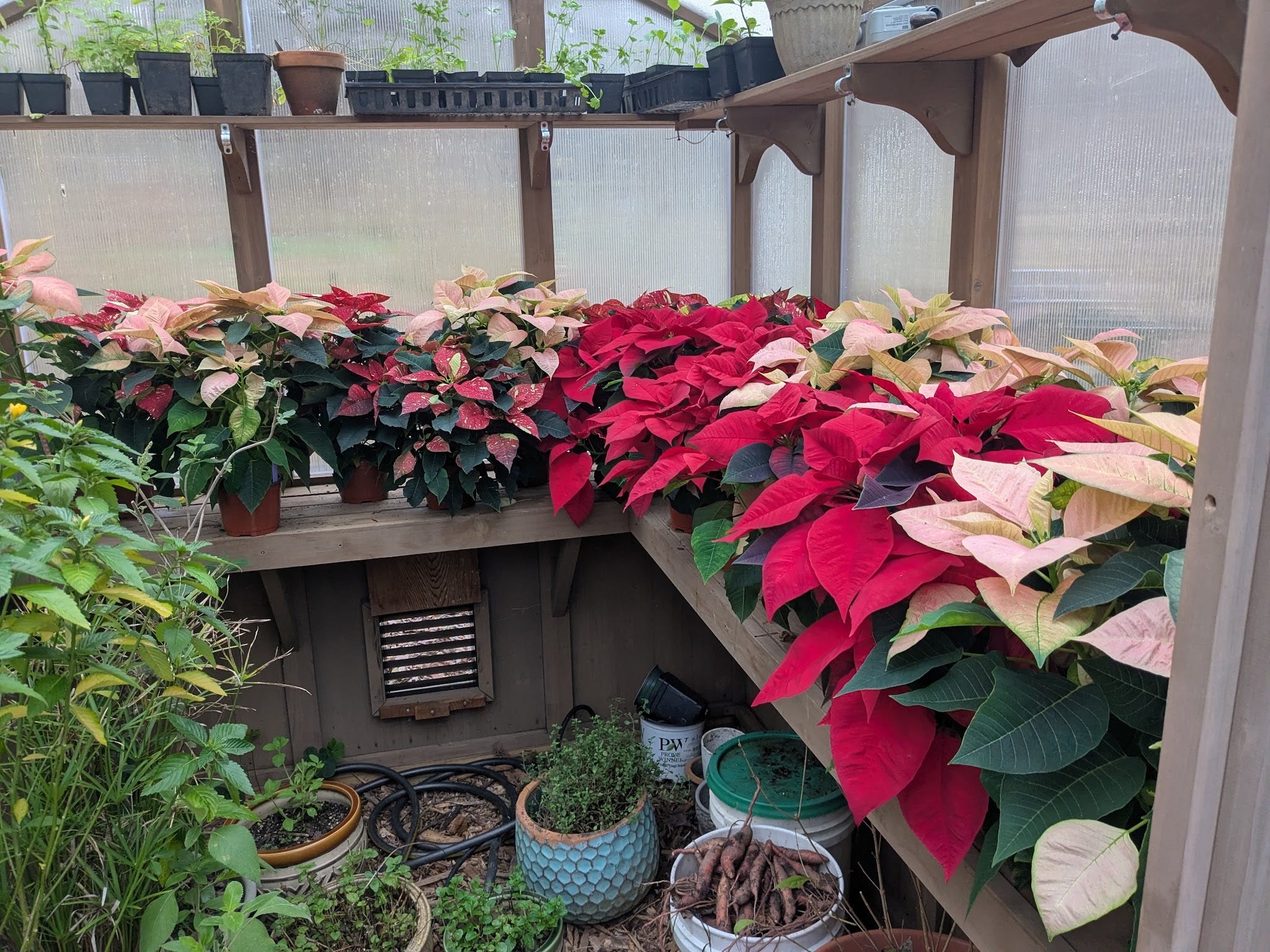
We have a small greenhouse where we winter over a variety of plants and get a head start on the summer garden. This week, in celebration of the solstice and the lengthening of the day, I will plant peppers. For the past month, we have cared for the Poinsettias that will honor the church altar for Christmas. Poinsettias are native to Mexico and Central America where they are known as nochebuena, “good night,” in a nod to Christmas Eve. When we agreed to keep them, I never imagined the joy they would bring. I have checked on them daily, making sure they have enough heat and water. On sunny days, when the green house warmed, I lingered with them, enjoying a rather tropical moment in the midst of winter. The color, the warmth, the smell, like Handel’s Messiah and Isaiah’s crocuses, like the radical voices of John and Henry, bring me great joy in the midst of this dark time.
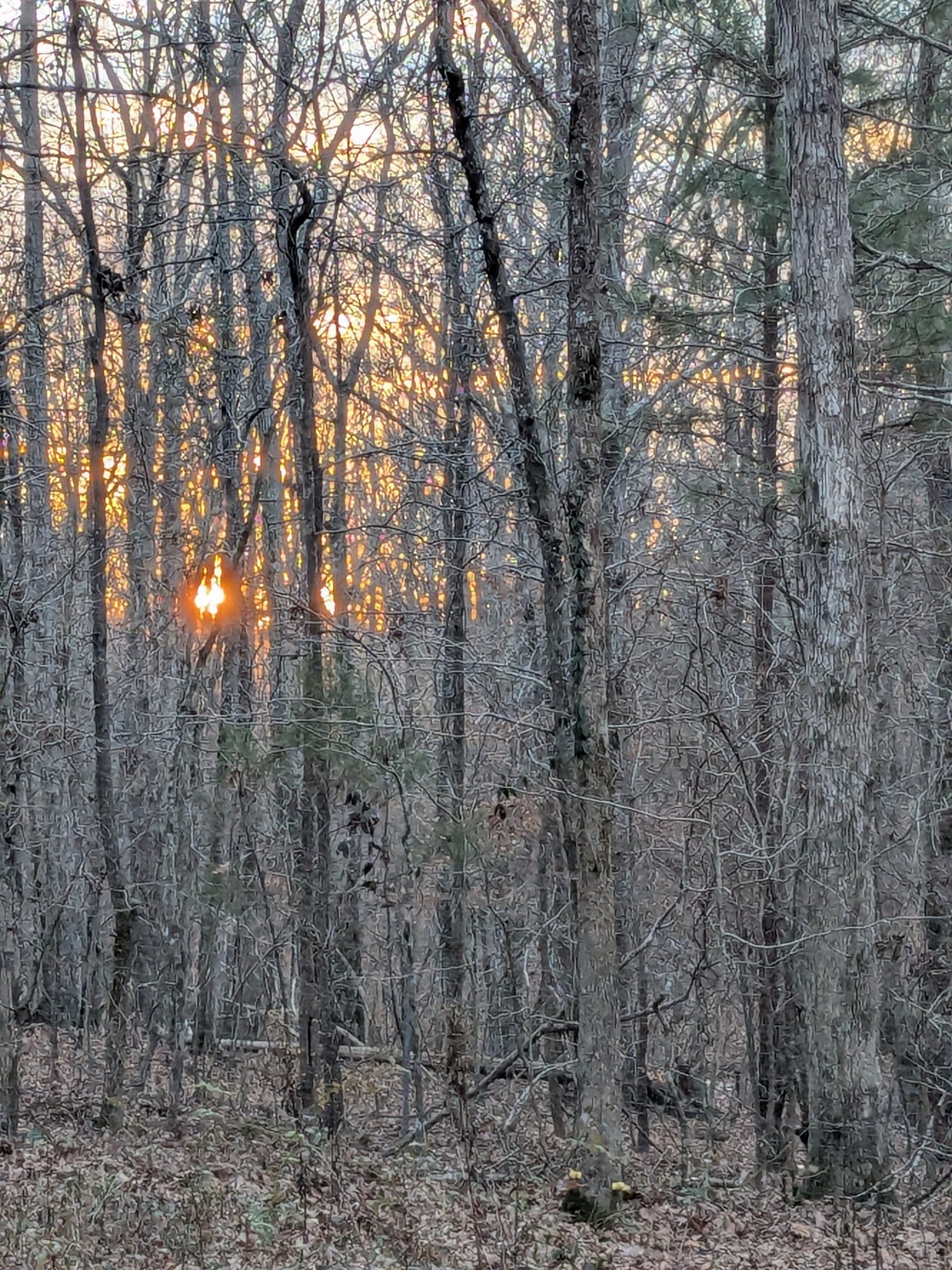
Tomorrow and for the next six months I will celebrate a bit more light each day in our half of the world, and each seed that germinates will, for me, serve as another green Bethlehem star.
On Living Well
If you haven’t already guessed, I’m a Thoreauvian by trade, and will most happily be attending the Thoreau Society Annual Gathering in the summer of 2026. The theme for this year’s program is “Living Well: Thoreau, Health, and Flourishing.”
As I prepare my proposal for the gathering, I’d love to hear what you think living well means. Please offer a note on this essay and your thoughts on living well in the comments.
On Life in the Garden
As the prophet Aldo Leopold says, “There are two spiritual dangers in not owning a farm. One is the danger of supposing that breakfast comes from the grocery, and the other that heat comes from the furnace.”
I have always known, as if born to it, as if I had germinated in the warmth of a spring day in the damp soil, that however the bills were paid, however I managed the business of money, my life’s meaning and truth would be found in the garden.
My writing offers insights on the life I find in the garden and celebrates the glories of the natural world as I work toward an ever greener mind. I hope you will subscribe.
The Community of a Fig Tree
On that day, says the Lord of hosts, you shall invite each other to come under your vine and fig tree.”
-- Zechariah 3:9-10
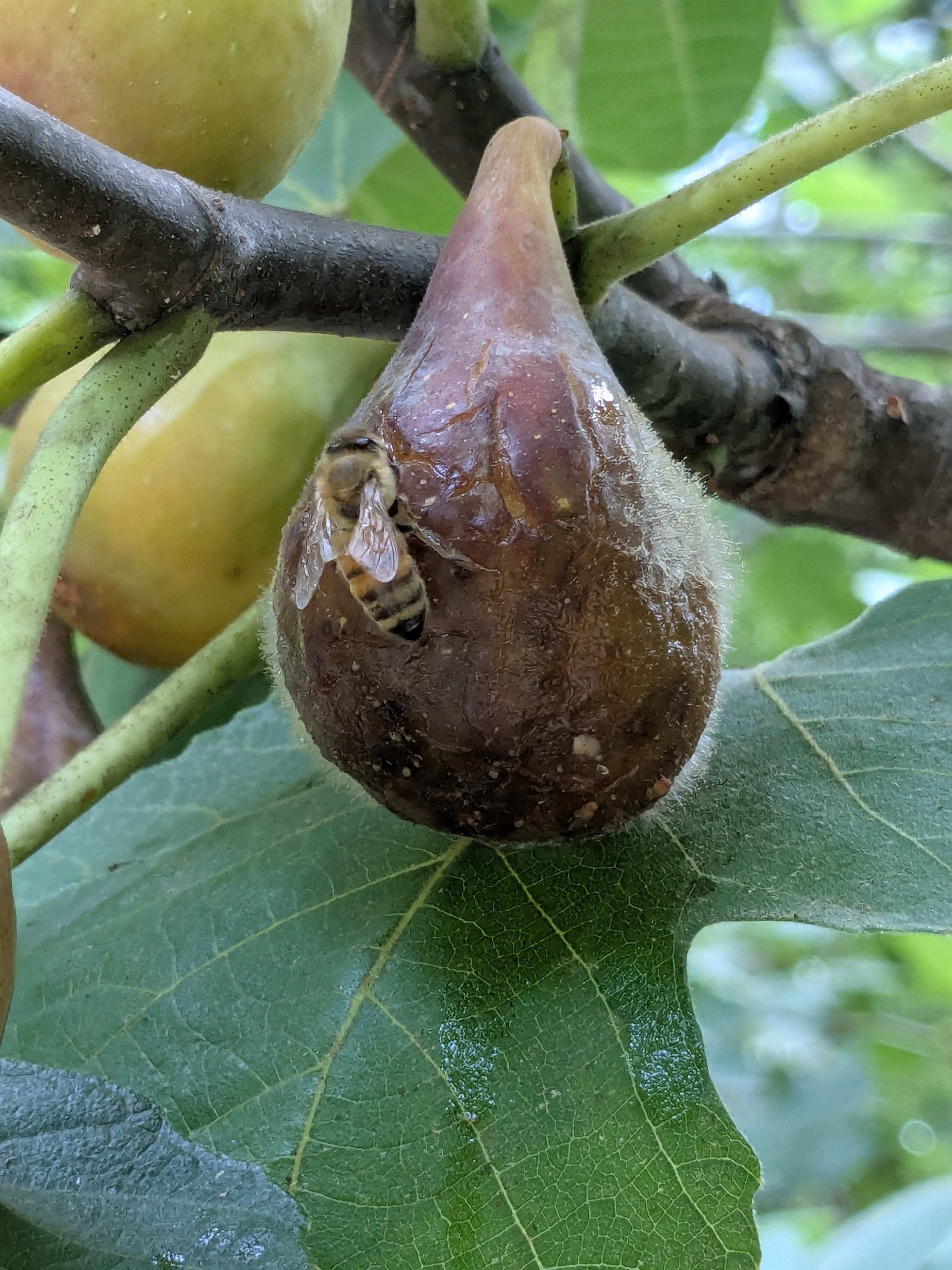
On a hot summer day in August of 2020, the figs on our farm, in riotous abundance, called me and many of the more than human world to enjoy the bounty. Sitting under the shade offered by the luscious leaves, I fell into a reverie at least in part inspired by the heat, the fermenting figs, and the buzz of 10,000 honey bees. My reflection on this reverie became the first chapter of A Book of Season, which will be published by Mercer University Press in May of 2026. Watch this Substack for information on how to order.
This has definitely been a time of reflection for me much, of which, has centered around defining a good life. I have partially settled on having the luxury of solitude. Not loneliness but the ability to choose to be quiet and peaceful with no distractions.
Right now, living well for me means allowing the ebbs and flows, waning and waxing, THE SEASONS inside. I am currently looking back and grieving the period of slowness and smallness that existed after having my two children: my home, my garden, my family, a few friends—that was the world! Now I am in a different season, and it is full of energy and excitement (and stress) forming and leading a new nonprofit to protect a wild space here in town. The quiet season before made it possible for me to do this work now. Winter into summer. Now the trick will be listening and observing well enough to know when the next season has arrived, and it’s time to slow down again. I wish it was as easy for me as it seems to be for the birds!