

I have fallen in love with beech trees (Fagus grandifolio). I was always fond of them, but over the years my affection has ripened into something deeper—something I’m not afraid to use the “L-word” to describe.
—Joan Maloof
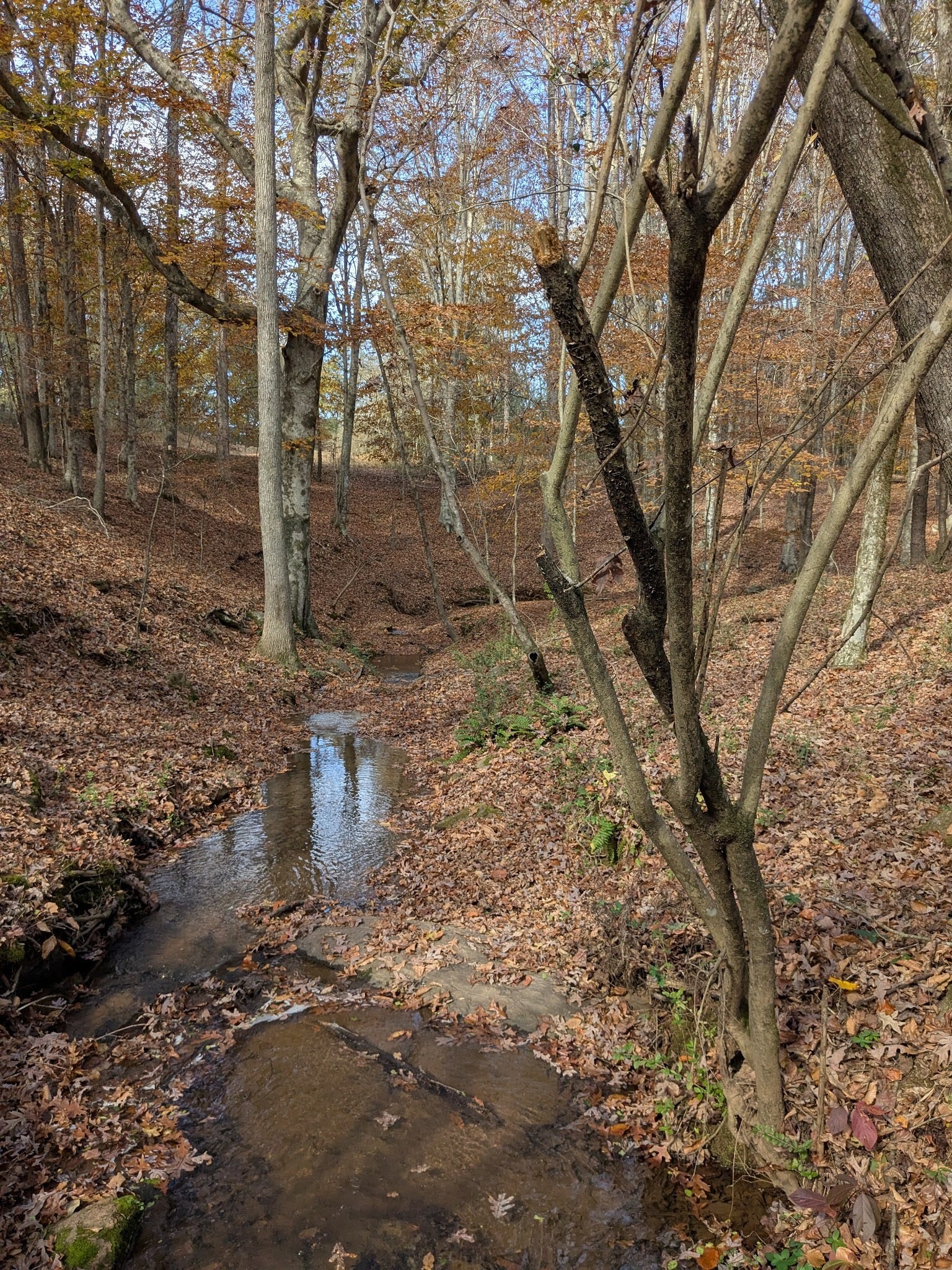
The American beech, a common tree in the eastern United States, prefers cooler, wetter northern slopes and can often be found along streams. Though it is sometimes found in pure stands, it happily lives with any number of other trees from poplar and gum to maples and magnolias.
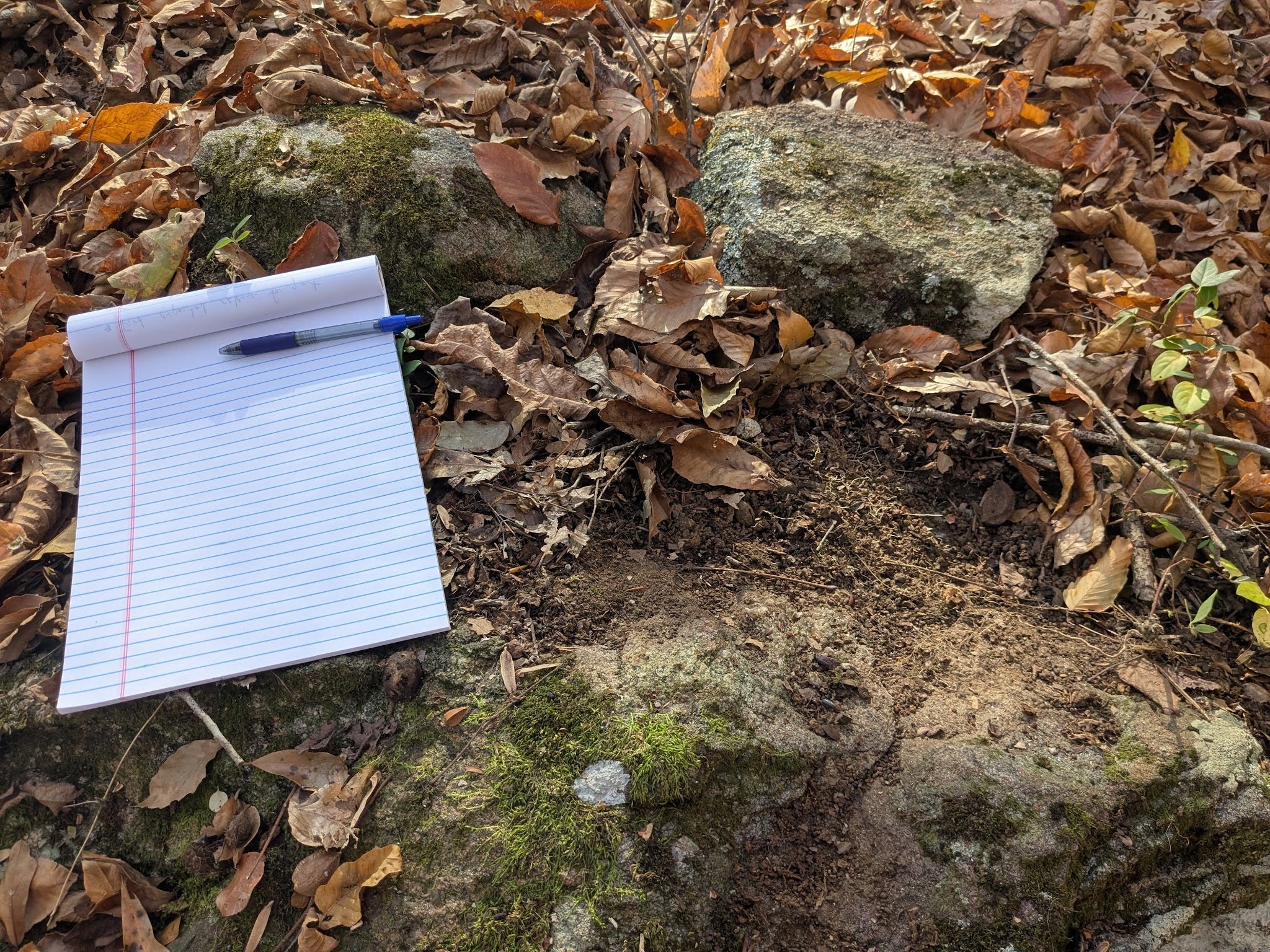
I’m sitting in a small mesic forest dominated by beeches on the Beech Bottom Trail in the Thomas Farm Preserve in Watkinsville, Ga. The day is spectacular: warm enough in late November to bring out the honey bees in search of late pollen. The variations of breeze trigger successive generations of leaf fall. Time slows as I watch the acrobatics of the leaves’ descent till they gently land to join their siblings. The sun, over my left shoulder, shines on my tablet as I write, my shadow indistinguishable from those cast by the young trees behind me. An occasional cloud interrupts the sun and obscures the bright blue above the trees.
I say that the trees behind me are young, but that assumes my all-too-human perception of time. Time is remarkably different for trees, especially slow growers like beeches. One of our own young beech trees, just now twelve or so feet tall, has grown near our home for thirty years. It patiently waits for the crown to open up for its day in the sun. As Maloof notes, their gradual growth makes them a poor investment for those who look only at the money to be made, for those who see a human lifespan as the defining factor. As we Georgians know well, fast growing pines are the preferred arboreal crop of the land. Beeches, to my mind, have a far greater value.
The gentle slope on which I sit marks hundreds of years of gradual erosion. A creek, bound by granite gneiss, trickles by in the bottom. The water spills over the rock into a pool, its song just audible over the sound of the breeze. Newly fallen leaves circle the pool till, like kids at play, they slide down the mossy stones to circle yet another pool. Cardinals add their percussive cheep to the creek’s sibilance. Crows now and again caw.
The hundred acre preserve was only recently made a municipal green space, and it has been embraced by the community. It was a family farm for some generations, and the family’s love of the land is apparent throughout, certainly here in the beech bottom. Mr. “Hot” Thomas, the patriarch in our lifetime, was famous for his BBQ, and he took orders from us over the years at the cement block general store transformed–by his facility with pork–into a restaurant. The shelves of the store held an array of odds and ends, more or less useful to the local farmers. Thus, your order could include a pulled pork sandwich with vinegar sauce, slaw, white bread, pie, ice tea, and a crescent wrench. It was the closest restaurant to our 10 acres in south Oconee County. From there, anyone in a touristy mood could swing on down Highway 15 to the river to take in the Iron Horse, the modern art that found its home in the middle of a corn field after being rejected by the fine young students at the university in the late fifties.
On the hundred acre homestead of the Thomas family on the outskirts of Watkinsville, just past the cemetery, the family lived and raised cattle and grew pecans. The woods where I sit must have been left alone for a very long time. With trunks 14 to 16 inches at the base, these beeches could well have watched this creek run for 150 years. With a lifespan of more than 350 years, the parent of the trees around me could well have germinated before the Pilgrims sailed for Plymouth. How the world surrounding this quiet corner has changed!
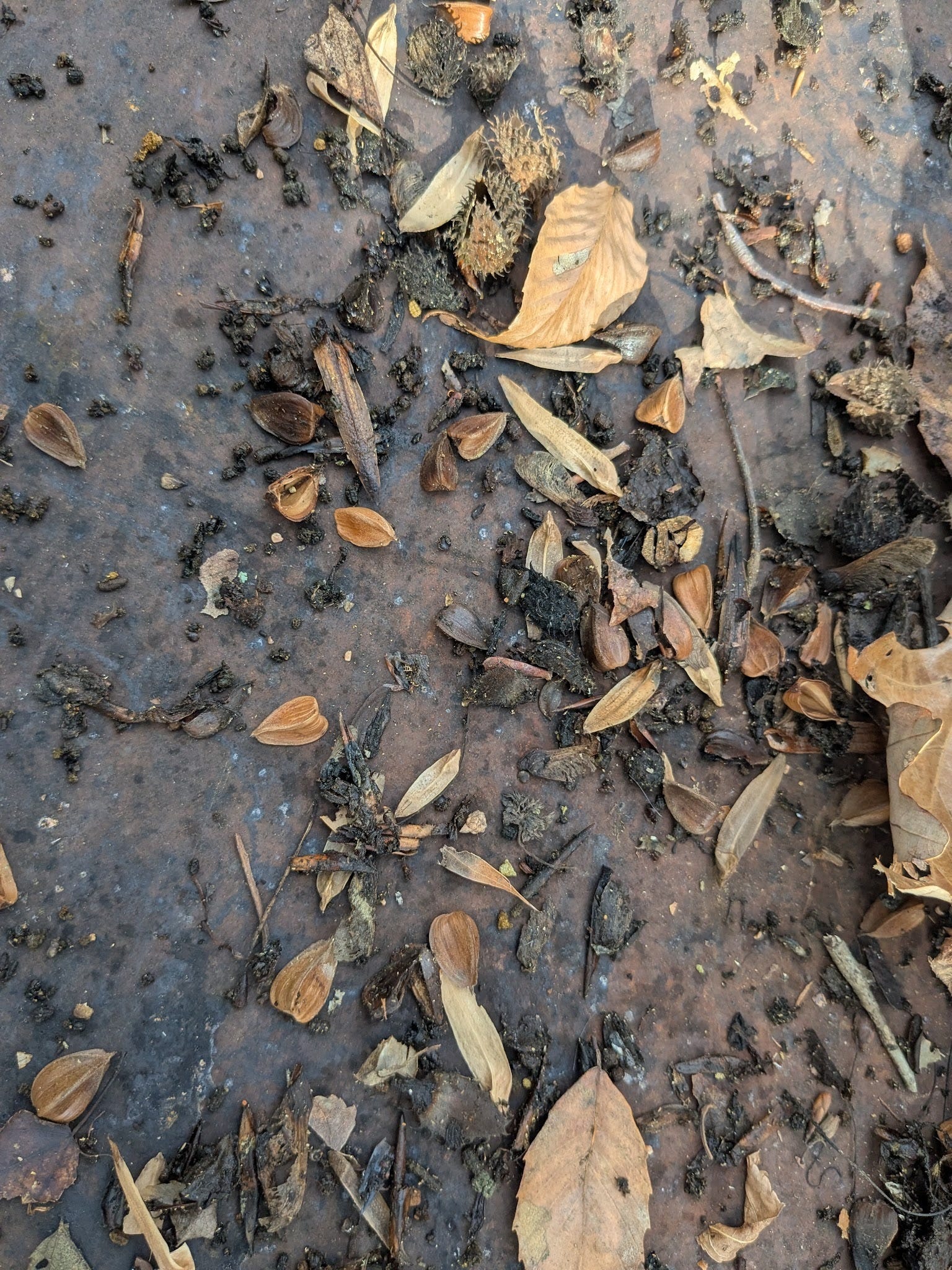
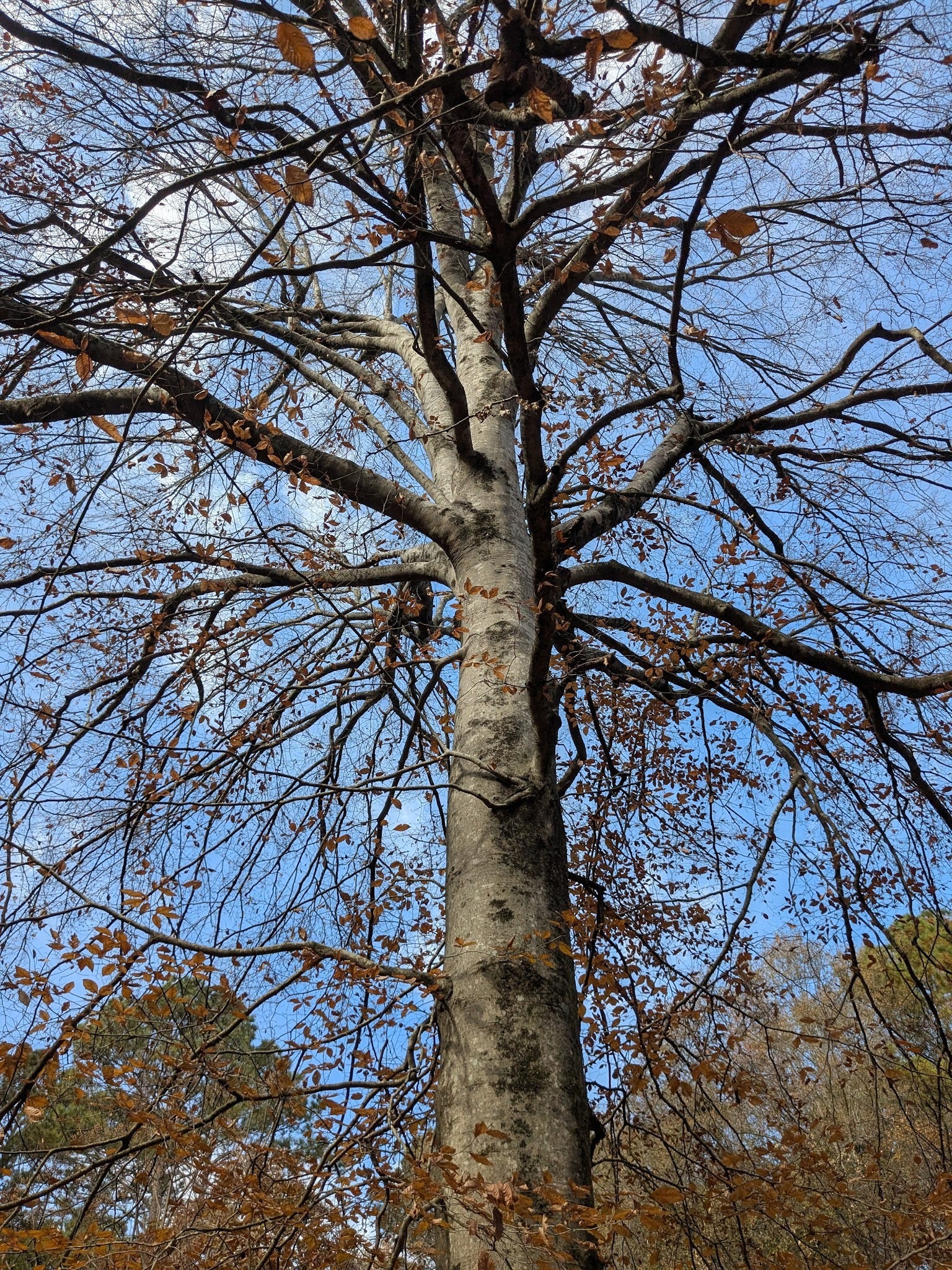
The botanic name of the beech is Fagus grandifolio, fagus from the Greek “to eat” and grandifolio meaning “big leaf,” as the American beech sports larger leaves than its European cousin. These trees, no doubt, have fed multitudes of the more-than-human world for generations upon generations. Their seeds are high in oil, making them a fine meal for squirrels, chipmunks, deer, foxes, and birds. This year has been a mast year for the oaks, with acorns aplenty, but the beechnuts have also rained down in abundance. The etymology of “beech” shares a common heritage with “book” as its smooth blue-gray bark served as an early form of tablet. The smoothness of the bark still attracts young folks who feel compelled to announce their love with a knife. Though I haven’t snacked on beechnuts as I sit beneath these beauties, yet have I been fed in so many lovely ways. Though I haven’t defaced the smooth bark, these trees inspired these words.
In my lifetime, I have seen an array of species with different life-cycles, each with their own time frame. The periodic cicadas are most famous for their long slow development and their striking emergence. At the intersection of ecology and systems theory, we find the delightful concept of “emergence,” the notion that what the parts of a system do together, they could not do alone. Sitting here, I begin to wonder what has been lost by our insistence on the short-term cycle, the immediate payoff. What, indeed, might have emerged from the slow development of an ecosystem like the one here anchored by beech trees. Joan Maloof notes, “I have come to believe that the only moral solution to the paradox [that living on earth requires harming other organisms] is to strive to minimize our impacts and to be utterly clear about the impacts we are having.” Though we will never know what we have lost, we can be utterly clear that we have lost much by interrupting the complex systems that are found in old growth forests.
I breathe in deeply, the air suffused with the sweet smell of fall. What wonders might emerge in this beech bottom if we continue to minimize our impacts? What words might find their way to the young minds sitting here under the next generation of beeches?
Let Me Know Your Thoughts
I’d love to hear about your favorite spot among the trees this fall.
On Joan Maloof
Inspiration for this essay and the quotations above are from Joan Maloof’s essay “Beeches” from her book Teaching the Trees. For more about Joan Maloof, please visit https://www.joanmaloof.com/
For more information about old growth forests, check out The Old Growth Forest Network, an organization that Joan founded: https://www.oldgrowthforest.net/
On Life in the Garden
As the prophet Aldo Leopold says, “There are two spiritual dangers in not owning a farm. One is the danger of supposing that breakfast comes from the grocery, and the other that heat comes from the furnace.”
I have always known, as if born to it, as if I had germinated in the warmth of a spring day in the damp soil, that however the bills were paid, however I managed the business of money, my life’s meaning and truth would be found in the garden.
My writing offers insights on the life I find in the garden and celebrates the glories of the natural world as I work toward an ever greener mind. I hope you will subscribe.
The Community of a Fig Tree
On that day, says the Lord of hosts, you shall invite each other to come under your vine and fig tree.”
-- Zechariah 3:9-10
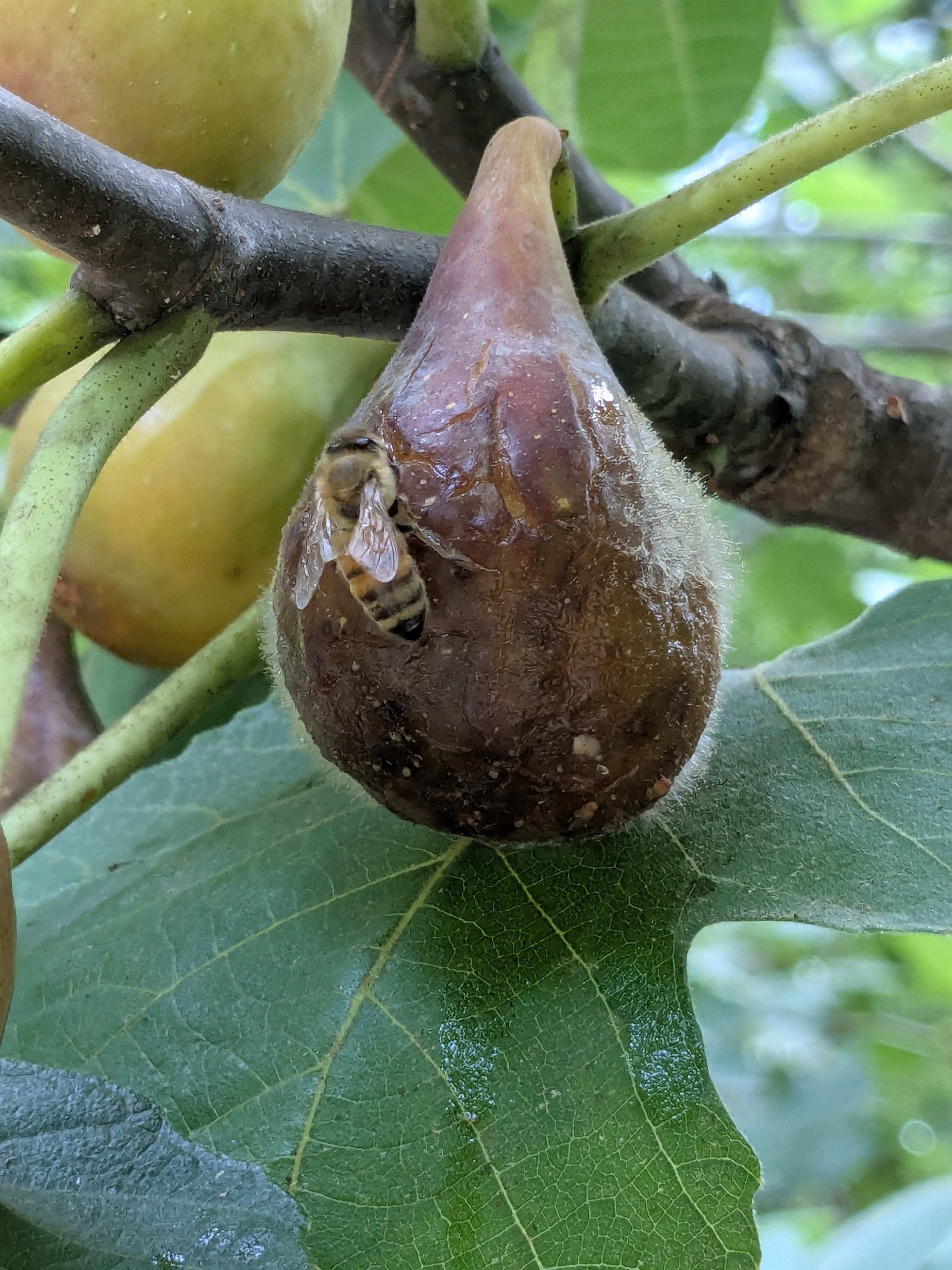
On a hot summer day in August of 2020, the figs on our farm, in riotous abundance, called me and many of the more than human world to enjoy the bounty. Sitting under the shade offered by the luscious leaves, I fell into a reverie at least in part inspired by the heat, the fermenting figs, and the buzz of 10,000 honey bees. My reflection on this reverie became the first chapter of A Book of Season, which will be published by Mercer University Press in May of 2026. Watch this Substack for information on how to order.
I find peace behind your writing. It's a lovely Oconee spot and you just brought it to life for me. I think I need to take my sketch pad and work on some watercolor and poetry.
Thanks for sharing this lovely meander. I love the history of the land part, and especially the details about the place where you could buy both a pulled pork sandwich and a crescent wrench. There once was a restaurant in Atlanta's Grant Park called D's Soul Food and TV Repair, which, too, is relegated to those of us with long memories and a hankering for fried chicken. Setting out to look for American Beech trees on my woodlands hike today. Will send photos!